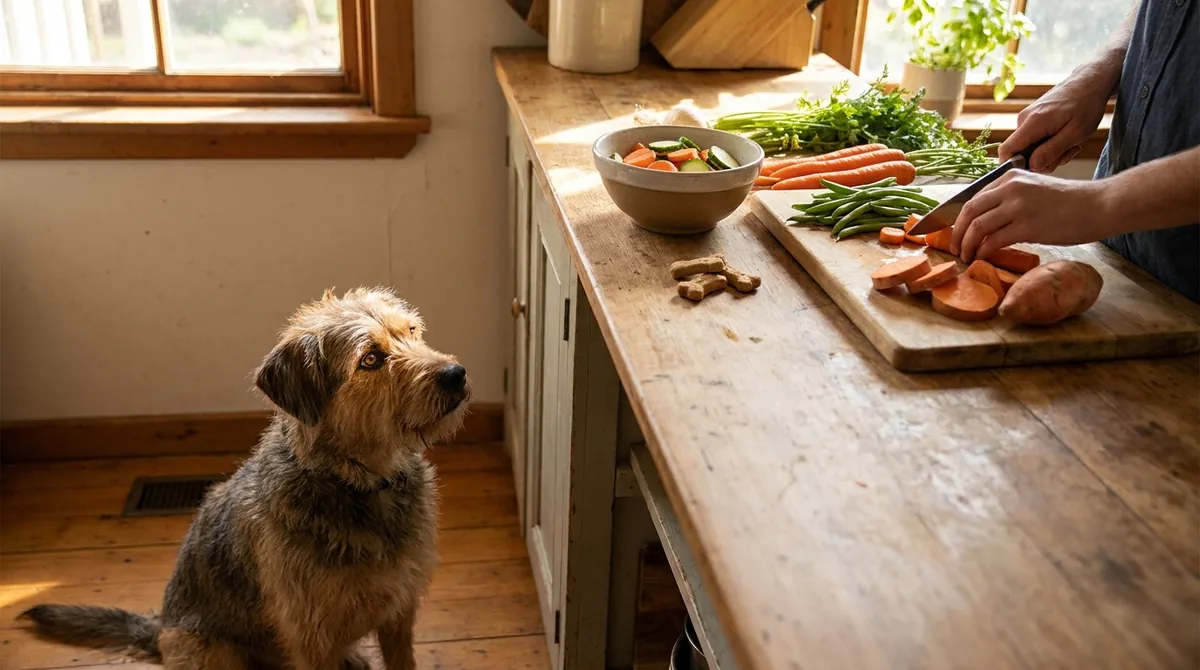
“Leave it” should teach disengagement, not fear of your hands. Start with low-value food protected under your hand, wait for the dog to back away, then reward from the other hand. The dog learns that moving away from one item earns something better. Only later should you add the verbal cue and practice with objects on the floor.
Teach the concept with low stakes
Hold a boring treat in a closed fist. Wait quietly. The moment the dog moves the nose away, mark and reward from the other hand.
Reward disengagement, not endurance
You are teaching 'moving away makes something better happen,' not testing how long the dog can resist temptation.
Move to the floor with protection
Place an item under your shoe or hand so the dog cannot grab it. Reward looking away or checking in with you.
Generalize carefully
Practice with household items, outdoor food and moving objects at safe distances. Real-world items can be much harder than a training setup.
Manage dangerous objects
Do not turn poison, medication, sharp objects or traffic into a training test. Physically prevent access and use your emergency plan.
A practical plan you can use this week
Set up the easy version
Begin with use boring food, a quiet room and rewards that are clearly more valuable than the item being left. Keep the first repetitions deliberately easy. A dog who can succeed has a clear behavior to repeat; a dog who is already over threshold or physically struggling is mostly rehearsing the problem.
Make the first repetition obvious
For the first session, cover the low-value item with your hand, wait silently for the dog to stop investigating, mark that instant and feed from the opposite hand. The goal is not endurance. It is a clean, understandable success that can be repeated before adding duration, distance or distraction.
Progress one variable at a time
Once the easy version is fluent, move from closed hand to open hand, then floor items, then dropped objects while keeping a leash or barrier for safety. If performance suddenly falls apart, reduce difficulty rather than repeating the cue more loudly or assuming the dog is being defiant.
Transfer the skill to ordinary life
Real progress comes from using the skill where it matters. practice with tissues, street food at a distance and household items, but never stage dangerous toxin exposures as training tests. Short planned repetitions in normal routines are usually more valuable than one long weekend session.
Track the change you can actually see
Use a simple success marker: the dog disengages faster and begins looking to the handler after noticing a tempting item. A written weekly note makes gradual improvement visible and helps you avoid changing the plan after one unusually good or difficult day.
Real-World Tip & Practical Observation
A useful observation is that “leave it” becomes fragile when owners only practice with food inches from the dog’s nose. Add distance before difficulty. Seeing a sandwich on the pavement from two metres away and turning back to you is a better real-world rehearsal than repeatedly hovering over a biscuit under your shoe.
Common mistakes that make the problem harder
- Saying the cue while physically wrestling an object from the dog.
- Repeating the word rapidly instead of setting up one clear choice.
- Testing with dangerous foods or sharp objects before the skill is reliable.
- Confusing “leave it” with “drop it,” which is used after the dog already has something.
What progress should look like
The best sign of learning is voluntary disengagement. Over time, the dog should notice the item and orient back to you before you have to manage it physically. Continue using barriers and leashes around true hazards.
An owner checklist for the next seven days
Day one is for observation and setup: use boring food, a quiet room and rewards that are clearly more valuable than the item being left. On the next two days, use this first step: cover the low-value item with your hand, wait silently for the dog to stop investigating, mark that instant and feed from the opposite hand. Keep sessions short enough that you can stop after a good repetition rather than waiting for the dog to become tired, frustrated or distracted. Write down what happened immediately before the behavior, what you did, and what the dog did next. That simple record is more useful than relying on memory at the end of the week.
From days four through seven, change only one difficulty at a time. move from closed hand to open hand, then floor items, then dropped objects while keeping a leash or barrier for safety. Use this practical measure: the dog disengages faster and begins looking to the handler after noticing a tempting item. If the numbers or observations get worse for two sessions in a row, make the task easier and rebuild success. The aim is not a perfect dog by Sunday; it is a repeatable routine that gives the dog clear information and gives you evidence that the plan is moving in the right direction.
Frequently asked questions
What is the difference between leave it and drop it?
Leave it means do not take or approach the item. Drop it means release something already in the mouth. Teach them as separate skills.
Should I punish the dog for grabbing the item?
No. Punishment can create guarding or make the dog swallow faster. Use management and train the alternative response at easier levels.
Can leave it stop scavenging outside?
It can help, but environmental management and leash skills are still important. Heavy scavengers may need additional safety strategies.
Sources & further reading
Training and behavior references selected for How to Teach Leave It Without Scaring Your Dog. These organizations are independent of Dogtation and are included so readers can verify the underlying guidance.