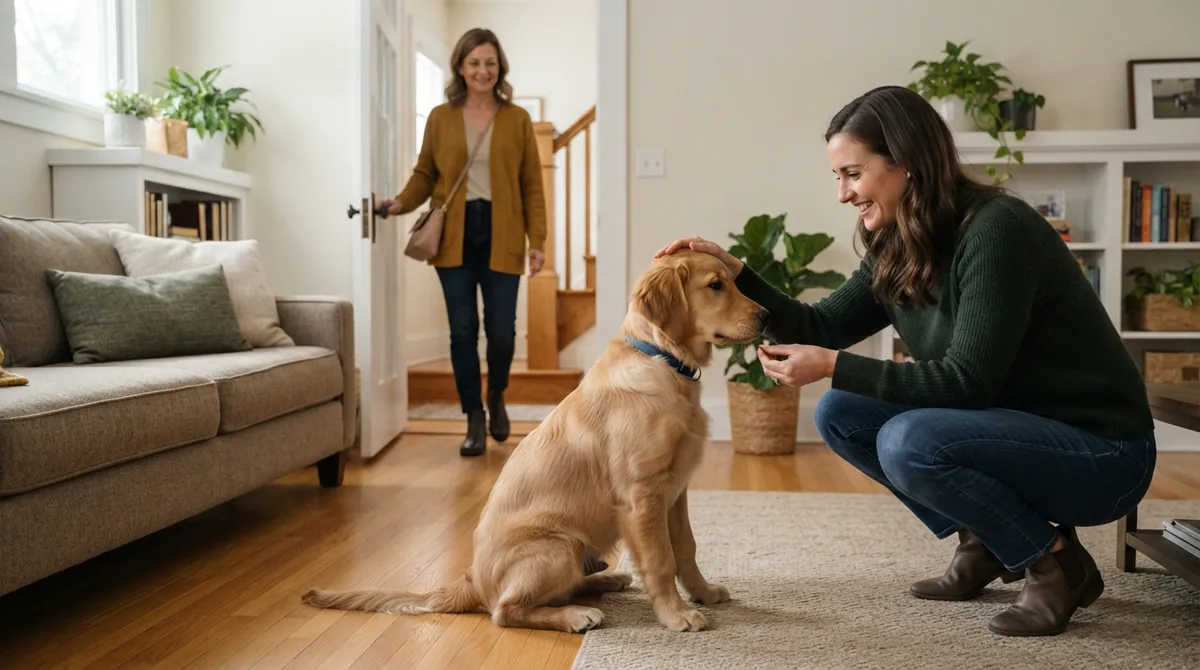
Jumping improves fastest when the dog cannot keep rehearsing it and when calm alternatives are rewarded before the guest is within reach. Use a leash, gate or mat, coach visitors to withhold attention during jumping, and pay heavily for four paws on the floor. Waiting until the dog is already airborne makes the problem much harder to solve.
Control the doorway first
Use a leash, gate or stationing mat before opening the door. Training is much easier when the dog cannot repeatedly launch at the guest.
Choose one replacement behavior
Four paws on the floor, a sit or going to a mat can all work. Pick the behavior your household can reinforce consistently.
Make guest attention contingent
Guests should greet when the dog is calm and pause attention if jumping resumes. The environment must stop paying for the behavior you are trying to reduce.
Practice without real guests
Rehearse door sounds, walking to the mat and receiving rewards when no one important is arriving. Then add familiar helpers before surprise visitors.
Account for fear and over-arousal
Not all jumping is friendly exuberance. If the dog is fearful, barking intensely or unable to recover, reduce social pressure and seek professional guidance.
A practical plan you can use this week
Set up the easy version
Begin with stage practice with one calm helper, a leash or gate and treats placed where the handler can reach them before opening the door. Keep the first repetitions deliberately easy. A dog who can succeed has a clear behavior to repeat; a dog who is already over threshold or physically struggling is mostly rehearsing the problem.
Make the first repetition obvious
For the first session, reward the dog for staying grounded while the helper enters at a distance; if jumping begins, the helper calmly steps away. The goal is not endurance. It is a clean, understandable success that can be repeated before adding duration, distance or distraction.
Progress one variable at a time
Once the easy version is fluent, decrease distance and increase greeting duration only while the dog can keep paws down or return to a mat. If performance suddenly falls apart, reduce difficulty rather than repeating the cue more loudly or assuming the dog is being defiant.
Transfer the skill to ordinary life
Real progress comes from using the skill where it matters. use the same routine for delivery people, family members and exciting friends instead of changing rules depending on the visitor. Short planned repetitions in normal routines are usually more valuable than one long weekend session.
Track the change you can actually see
Use a simple success marker: fewer launch attempts and a faster shift to sitting, standing calmly or going to the mat when the door routine starts. A written weekly note makes gradual improvement visible and helps you avoid changing the plan after one unusually good or difficult day.
Real-World Tip & Practical Observation
Real homes often fail because the guest becomes part of the chaos. Tell the helper the rule before they enter: “If paws come up, turn away; when paws are down, greet.” A ten-second rehearsal with a cooperative friend is more useful than trying to train during a birthday party with six excited visitors.
Common mistakes that make the problem harder
- Pushing the dog off with hands, which can feel like attention or play.
- Asking for a sit after the dog has already jumped repeatedly and become highly aroused.
- Allowing some visitors to encourage jumping while expecting perfect manners with others.
- Removing every greeting opportunity instead of teaching a calm way to access social contact.
What progress should look like
You are looking for a change in the dog’s first choice when the door opens. A dog who pauses, checks in or moves toward a mat is showing learning even if excitement still needs management.
An owner checklist for the next seven days
Day one is for observation and setup: stage practice with one calm helper, a leash or gate and treats placed where the handler can reach them before opening the door. On the next two days, use this first step: reward the dog for staying grounded while the helper enters at a distance; if jumping begins, the helper calmly steps away. Keep sessions short enough that you can stop after a good repetition rather than waiting for the dog to become tired, frustrated or distracted. Write down what happened immediately before the behavior, what you did, and what the dog did next. That simple record is more useful than relying on memory at the end of the week.
From days four through seven, change only one difficulty at a time. decrease distance and increase greeting duration only while the dog can keep paws down or return to a mat. Use this practical measure: fewer launch attempts and a faster shift to sitting, standing calmly or going to the mat when the door routine starts. If the numbers or observations get worse for two sessions in a row, make the task easier and rebuild success. The aim is not a perfect dog by Sunday; it is a repeatable routine that gives the dog clear information and gives you evidence that the plan is moving in the right direction.
Frequently asked questions
Should I use kneeing or leash corrections?
No. Physical corrections can increase conflict or fear and do not clearly teach what behavior earns the greeting.
What if my dog jumps only on certain people?
Practice with people who reproduce that level of excitement, but start at a greater distance or behind a gate.
Can I teach a sit instead?
Yes, if sitting is comfortable and sustainable for the dog. Four paws on the floor or a mat can be easier for very excited dogs.
Sources & further reading
Training and behavior references selected for How to Stop a Dog From Jumping on Guests. These organizations are independent of Dogtation and are included so readers can verify the underlying guidance.