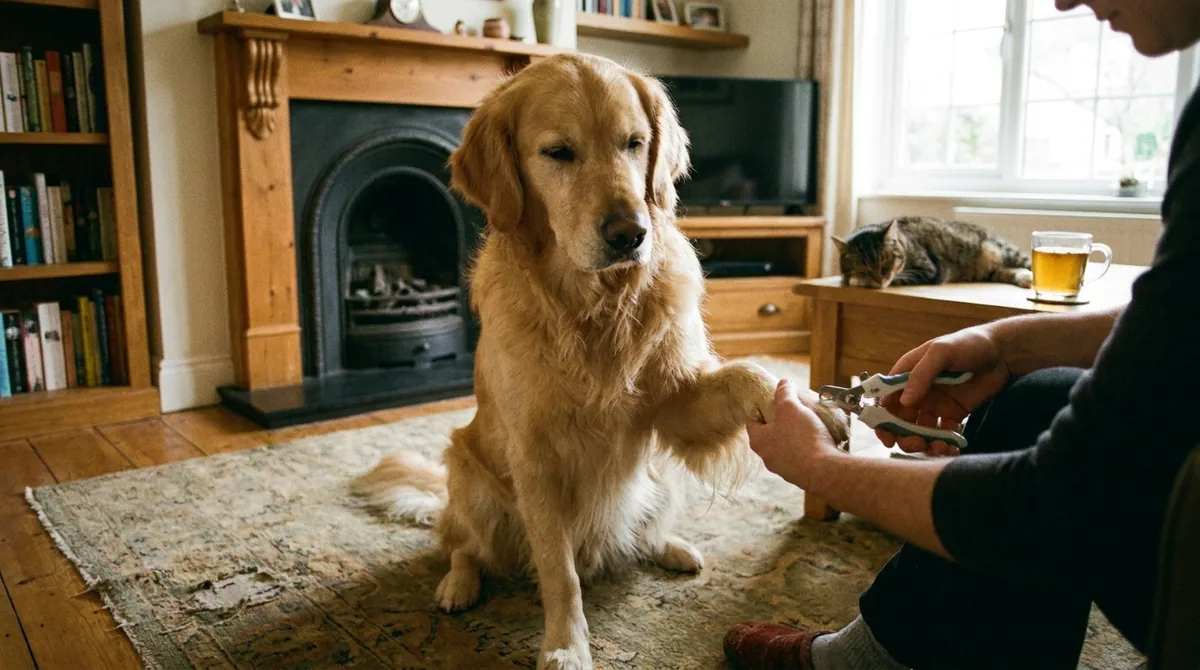
Nail care becomes much easier when handling, tool noise and tiny trims are trained as separate skills. Start by touching a shoulder, moving down the leg, briefly holding a paw and rewarding before you ever cut a nail. When the dog is comfortable, trim very small amounts and stop while the session is still easy rather than trying to finish every paw at once.
Train before you trim
Reward your dog for allowing a brief paw touch, then for seeing the tool, hearing it and feeling it near the nail.
Do one nail if needed
There is no rule that all nails must be completed in one session. Success with one or two nails can build confidence.
Know the quick
The quick contains blood vessels and nerves. Dark nails make it harder to see, so trim conservatively or ask a groomer or veterinary professional to demonstrate.
Use traction and comfortable positioning
A non-slip surface and a position the dog can maintain without struggling improves safety.
Escalating fear needs a different plan
If nail care triggers panic or defensive behavior, stop forcing it and work on cooperative care. A professional can help with training and safe handling.
A practical plan you can use this week
Set up the easy version
Begin with choose a quiet non-slip surface, prepare sharp clippers or a grinder you know how to use, and have high-value rewards within reach. Keep the first repetitions deliberately easy. A dog who can succeed has a clear behavior to repeat; a dog who is already over threshold or physically struggling is mostly rehearsing the problem.
Make the first repetition obvious
For the first session, reward shoulder and leg handling, then paw contact, toe separation and the tool touching the nail without cutting. The goal is not endurance. It is a clean, understandable success that can be repeated before adding duration, distance or distraction.
Progress one variable at a time
Once the easy version is fluent, clip or grind one tiny amount from one nail, reward, and build the number of nails only as the dog remains relaxed. If performance suddenly falls apart, reduce difficulty rather than repeating the cue more loudly or assuming the dog is being defiant.
Transfer the skill to ordinary life
Real progress comes from using the skill where it matters. practice two-minute handling sessions between actual trims so the dog does not learn that paw contact always predicts cutting. Short planned repetitions in normal routines are usually more valuable than one long weekend session.
Track the change you can actually see
Use a simple success marker: less paw pulling, faster recovery after tool contact and the ability to complete more nails without restraint or conflict. A written weekly note makes gradual improvement visible and helps you avoid changing the plan after one unusually good or difficult day.
Real-World Tip & Practical Observation
For dogs with dark nails, owners often feel pressured to take off a large amount in one session. A safer practical rhythm is frequent tiny trims. You reduce the chance of cutting the quick and you also get many short training repetitions. Mark the date and aim for consistency rather than trying to “catch up” with one stressful marathon.
Common mistakes that make the problem harder
- Holding the dog down to finish all nails after early stress signals appear.
- Using dull clippers that crush rather than cut cleanly.
- Only touching paws on nail-trim day.
- Punishing pulling away instead of reducing the step and rebuilding comfort.
What progress should look like
Success can mean one calm nail today and four next week. The emotional trend matters. If handling steadily becomes easier, the plan is working even before every session is complete.
An owner checklist for the next seven days
Day one is for observation and setup: choose a quiet non-slip surface, prepare sharp clippers or a grinder you know how to use, and have high-value rewards within reach. On the next two days, use this first step: reward shoulder and leg handling, then paw contact, toe separation and the tool touching the nail without cutting. Keep sessions short enough that you can stop after a good repetition rather than waiting for the dog to become tired, frustrated or distracted. Write down what happened immediately before the behavior, what you did, and what the dog did next. That simple record is more useful than relying on memory at the end of the week.
From days four through seven, change only one difficulty at a time. clip or grind one tiny amount from one nail, reward, and build the number of nails only as the dog remains relaxed. Use this practical measure: less paw pulling, faster recovery after tool contact and the ability to complete more nails without restraint or conflict. If the numbers or observations get worse for two sessions in a row, make the task easier and rebuild success. The aim is not a perfect dog by Sunday; it is a repeatable routine that gives the dog clear information and gives you evidence that the plan is moving in the right direction.
Frequently asked questions
What if I cut the quick?
Stay calm and stop the bleeding with an appropriate styptic product or veterinary guidance. If bleeding does not stop or the nail is badly injured, contact a veterinarian.
Are grinders better than clippers?
Some dogs prefer them and others dislike the sound or vibration. Either tool can work when introduced gradually and used safely.
How short should nails be?
Length varies with anatomy and lifestyle. Regular small trims and advice from a groomer or veterinary professional are safer than chasing an arbitrary visual length.
Sources & further reading
Daily-care references selected for Dog Nail Trimming Without a Wrestling Match. These organizations are independent of Dogtation and are included so readers can verify the underlying guidance.