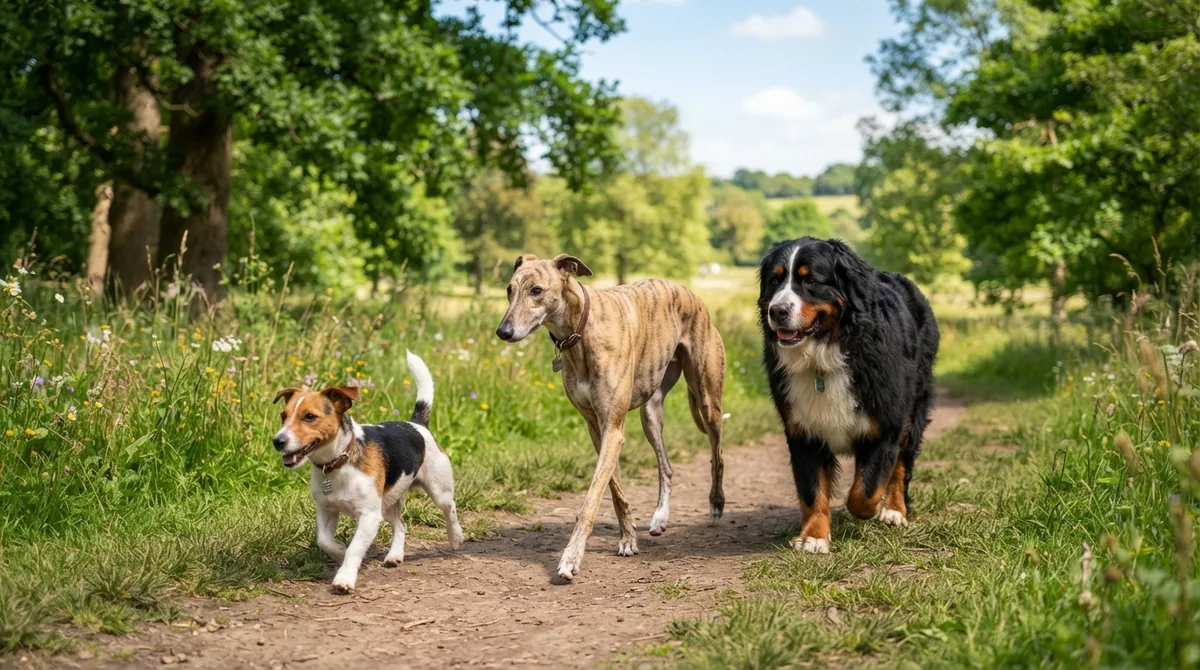
Breed groups are useful because they hint at the jobs dogs were selected to perform, but they are not personality tests. Herding dogs may be sensitive to movement, sporting dogs may love carrying and searching, terriers may persist after small prey, and guardian types may be more independent around strangers. Use the group as a question generator, then research the specific breed and individual.
Herding breeds notice movement
Many were selected to control livestock, so chasing, staring, quick responses and sensitivity to moving children, bikes or other animals can appear. Structured outlets and calmness training are often valuable.
Sporting breeds often work with people
Retrievers, pointers, setters and spaniels were developed for different parts of hunting. Many enjoy scent work, carrying objects, water or close cooperation, but exercise needs vary widely.
Terriers were built for persistence
Digging, chasing, grabbing and strong opinions can be normal expressions of the original job. Secure management and reinforcement for disengagement matter.
Working and guardian breeds can be powerful decision-makers
Some were selected for pulling, guarding property or protecting livestock. Size, strength, independence and stranger neutrality deserve serious planning.
Toy and companion dogs still need dog skills
A breed selected mainly for companionship can still need toilet training, enrichment, leash practice and respectful handling. Small size does not erase normal canine behavior.
A practical plan you can use this week
Set up the easy version
Begin with identify the historic job of every breed on your shortlist and write down which parts of that job would show up in your household. Keep the first repetitions deliberately easy. A dog who can succeed has a clear behavior to repeat; a dog who is already over threshold or physically struggling is mostly rehearsing the problem.
Make the first repetition obvious
For the first session, ask whether you enjoy the likely outlets—retrieving, scent games, structured training, hiking, grooming or calm guardian management. The goal is not endurance. It is a clean, understandable success that can be repeated before adding duration, distance or distraction.
Progress one variable at a time
Once the easy version is fluent, compare breed-group tendencies with individual lines, breeders, foster reports and adult dogs. If performance suddenly falls apart, reduce difficulty rather than repeating the cue more loudly or assuming the dog is being defiant.
Transfer the skill to ordinary life
Real progress comes from using the skill where it matters. visit training classes or breed events and watch how adult dogs of the type move, recover and interact rather than relying on short online clips. Short planned repetitions in normal routines are usually more valuable than one long weekend session.
Track the change you can actually see
Use a simple success marker: you can explain both the appealing and inconvenient parts of the breed’s original job before committing to the dog. A written weekly note makes gradual improvement visible and helps you avoid changing the plan after one unusually good or difficult day.
Real-World Tip & Practical Observation
A practical question for any breed is: “What behavior would be useful in the original job but annoying in my home?” A herder chasing motion, a terrier digging, a scent hound following odor or a guardian barking at arrivals are not moral failures. If you can plan outlets and management for that behavior, the match is much stronger.
Common mistakes that make the problem harder
- Assuming every member of a group has the same energy or temperament.
- Treating historical purpose as an excuse to skip training.
- Choosing a breed because one trait sounds impressive without considering the full package.
- Ignoring differences between working lines, show lines and individual family dogs.
What progress should look like
Group knowledge should make your questions sharper, not your conclusions absolute. It is most useful when it leads you to ask about exercise, social style, trainability, coat and management before choosing an individual.
An owner checklist for the next seven days
Day one is for observation and setup: identify the historic job of every breed on your shortlist and write down which parts of that job would show up in your household. On the next two days, use this first step: ask whether you enjoy the likely outlets—retrieving, scent games, structured training, hiking, grooming or calm guardian management. Keep sessions short enough that you can stop after a good repetition rather than waiting for the dog to become tired, frustrated or distracted. Write down what happened immediately before the behavior, what you did, and what the dog did next. That simple record is more useful than relying on memory at the end of the week.
From days four through seven, change only one difficulty at a time. compare breed-group tendencies with individual lines, breeders, foster reports and adult dogs. Use this practical measure: you can explain both the appealing and inconvenient parts of the breed’s original job before committing to the dog. If the numbers or observations get worse for two sessions in a row, make the task easier and rebuild success. The aim is not a perfect dog by Sunday; it is a repeatable routine that gives the dog clear information and gives you evidence that the plan is moving in the right direction.
Frequently asked questions
Are breed groups scientific behavior categories?
They are registry and historical classifications, not precise behavioral diagnoses. They summarize original purpose but individuals vary.
Do mixed breeds fit into a group?
A mixed dog may show traits associated with several ancestries, but observed behavior and individual history are more useful than guessing from appearance alone.
Which group is easiest for beginners?
There is no universally easiest group. The best match depends on household goals, time, experience and the specific dog.
Sources & further reading
Breed and ownership references selected for Working, Sporting, Herding or Companion? What Breed Groups Tell You. These organizations are independent of Dogtation and are included so readers can verify the underlying guidance.